Field notes / fundamentals
Your first run, without the early grave
Warhammer Survivors is not hard because the controls are complicated. It is hard because every second asks you to choose where to stand. This guide teaches the choices that keep a run alive long enough to become interesting.
On this page10 sections
The October demo is a short, curated slice of the full game. Use it to learn the movement language, not to grind a build that will be wiped at launch. The goal of a first run is simple: reach the first elite wave with a working weapon and a route out.
The first minute
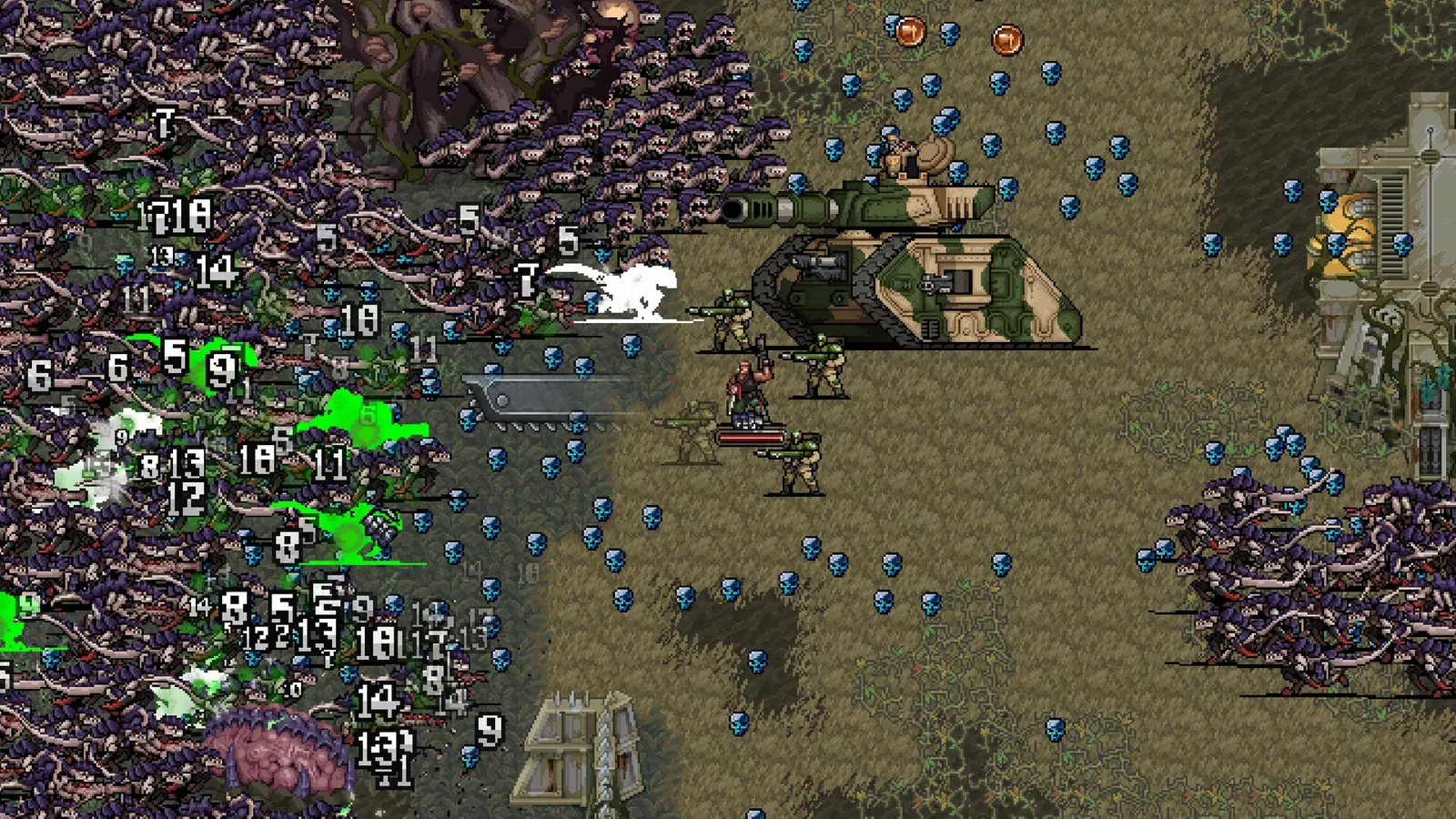
Start moving immediately. In the survivors loop, attacks fire automatically and movement is the active decision. The initial enemies are there to teach you the shape of the arena: where the open ground is, where the pack forms and how quickly a clean escape can become a trap.
Do not stop to fight the first wave. Walk a wide arc around it, collect the experience drops on your path and let your starting weapon meet the enemies following you. A run is not a series of duels; it is a moving economy of space, experience and damage.
First rule: attacks are automatic, so your attention belongs on the gaps, not the animations. If you are looking at the weapon, you are not looking at the next surround.
Choose a starter who works immediately
Malum Caedo is the safest first pick. His Chainsword swings in horizontal arcs, hitting multiple enemies without a setup item. You can learn the horde while the weapon does its job. If you prefer the Age of Sigmar side, Neave Blacktalon’s Tempest Axes provide constant whirling coverage and a documented evolution path.
Trooper Kozlowski is a strong second choice if you like ranged pressure and squad scaling. His Lasgun adds Cadian squadmates as it levels, but the early damage is less forgiving than a melee arc. Lyssa Revenya is excellent once you understand positioning; her hook is a reset button, not a replacement for movement.
- First run: Malum Caedo.
- AoS first run: Neave Blacktalon.
- Learn squad play: Trooper Kozlowski.
- Learn control: Lyssa Revenya after one or two successful runs.
The demo tier list explains the full ranking, including why Ulgromthier’s extra health is useful but not a substitute for positioning.
The survival loop
Every run follows the same rhythm:
- Collect experience skulls while moving around the outside of the pack.
- Choose an upgrade that strengthens the weapon or movement pattern you already rely on.
- Let the horde compress in front of your attack, then sweep around it.
- Clear elites for chests without crossing the centre of a dense screen.
- Prepare a pocket before the boss or rescue objective asks you to stand still.
The most common failure is treating the level-up screen as a shopping list. A build is a plan, not a collection. If the first two upgrades are for the Chainsword, the third should make the Chainsword’s job safer, not start a second project.
Commit to one evolution
Evolved weapons are the demo’s clearest power spikes. The catch is that most require two things: the base weapon and a specific passive companion. Carrying both and feeding them is more reliable than holding four unrelated weapons at level two.
The strongest documented example is Neave’s Tempest Axes + Sabaton → Whirlwind Axes. IGN performed that evolution in the October demo. The result is official; the exact level gate is not. Malum Caedo’s reportedChainsword + Tape Measure → Eviscerator Chainsword is a community lead, not a developer confirmation.
Pick one route, carry both pieces and check whether your build can survive while the pair levels. Theevolution finder lists every reported recipe with its evidence label, and therun planner can check a champion, weapon and companion combination before you start.
Elites, chests and rescues
Elite enemies are not just health checks. The October demo reports stronger enemies highlighted in green dropping chests that can contain several upgrades. That makes elite hunting a progression engine, but only if you can kill the elite without losing the run around it.
Rescue objectives use a question-mark marker. Trooper Kozlowski and the Legend of Catachan are both tied to demo rescue encounters. Approach from the outside, clear a wedge and leave along the same lane. A rescue ring is a fight with an objective inside; it is not a free recruit.
- Clear one side of the ring before entering.
- Kill the Synapse or elite guarding the objective first when possible.
- Do not cross the centre of the screen for a single experience drop.
- If the rescue fails, leave and re-enter from a new angle rather than forcing it.
Build a defensive layer
The demo is more demanding than a typical first survivors run. Healing can be scarce, and the horde escalates quickly. One defensive or mobility upgrade is not wasted damage; it is what lets the damage keep happening. Movement speed, max health, recovery or a reliable escape tool all buy the same thing: another decision.
The right time to take defence is before the screen becomes a solid wall, not after your health is already gone. If you cannot see a clean lane, that is the signal to invest in one.
Use pick-ups with intent
Pick-ups vary by universe. A Melta-Bomb has a delay, so it wants a mob being kited into its radius. A Blast Template is an emergency screen clear, not a routine wave tool. In Age of Sigmar, the Purple Sun of Shyish can hurt you as well as the enemy, and Ravenak’s Gnashing Jaws wants you to keep moving.
Frenzon is a burst window: take it when you have a safe place to attack, not when you are already running. Thestatus effect guide explains the interactions behind Burning, Poisoned and Oiled.
Before the boss
A boss fight is a crowd problem with a centrepiece. Clear a pocket before the boss arrives, keep the fight away from the arena edge and preserve one tool for the add wave. If the boss brings a faction with it — Ghazghkull’s Boyz, Vizzik’s Skaven — area coverage is part of the boss build.
Do not spend every upgrade on single-target damage and then discover you cannot reach the boss through the adds. Theboss files record what is confirmed and what is still hidden.
Five run-ending mistakes
- Reversing into the pack. A sharp turn to finish a straggler walks you into the next line.
- Starting four builds. Four half-finished weapons rarely beat one completed evolution.
- Ignoring the elite’s aura. Synapse, Bell of Doom and poison fog change the fight around the source.
- Standing still to collect. Experience is valuable; a clean escape route is more valuable.
- Hoarding pick-ups. A grenade saved for the perfect moment is often a grenade wasted after the surround.
First-run checklist
- Pick Caedo or Neave.
- Keep the horde in front of the attack and turn in wide arcs.
- Choose one evolution and carry both halves.
- Clear a rescue ring from the outside.
- Take one defensive or movement upgrade before the elite wave.
- Use a pick-up to create space, not to chase a kill.
- Clear a boss pocket and keep a lateral exit.
Once the first run reaches the boss with health left, the next step is a build plan. Open thebuilds and run planner, or compare the demo tier list before choosing your second champion.
Sources and evidence
Editorial methodOfficial claims, press observations and community reports are kept separate. Where Auroch has not published a value, this guide says so instead of filling the gap.